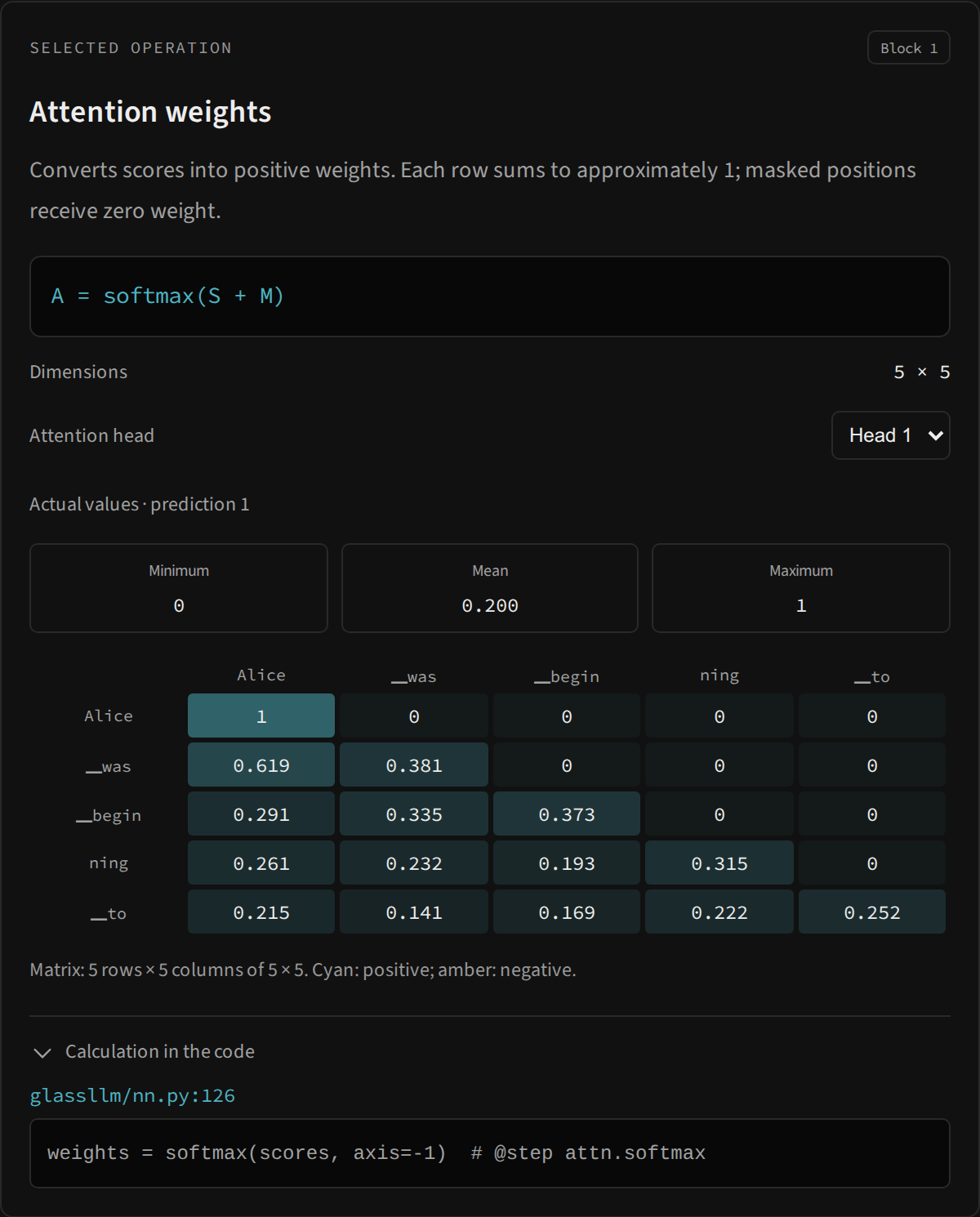
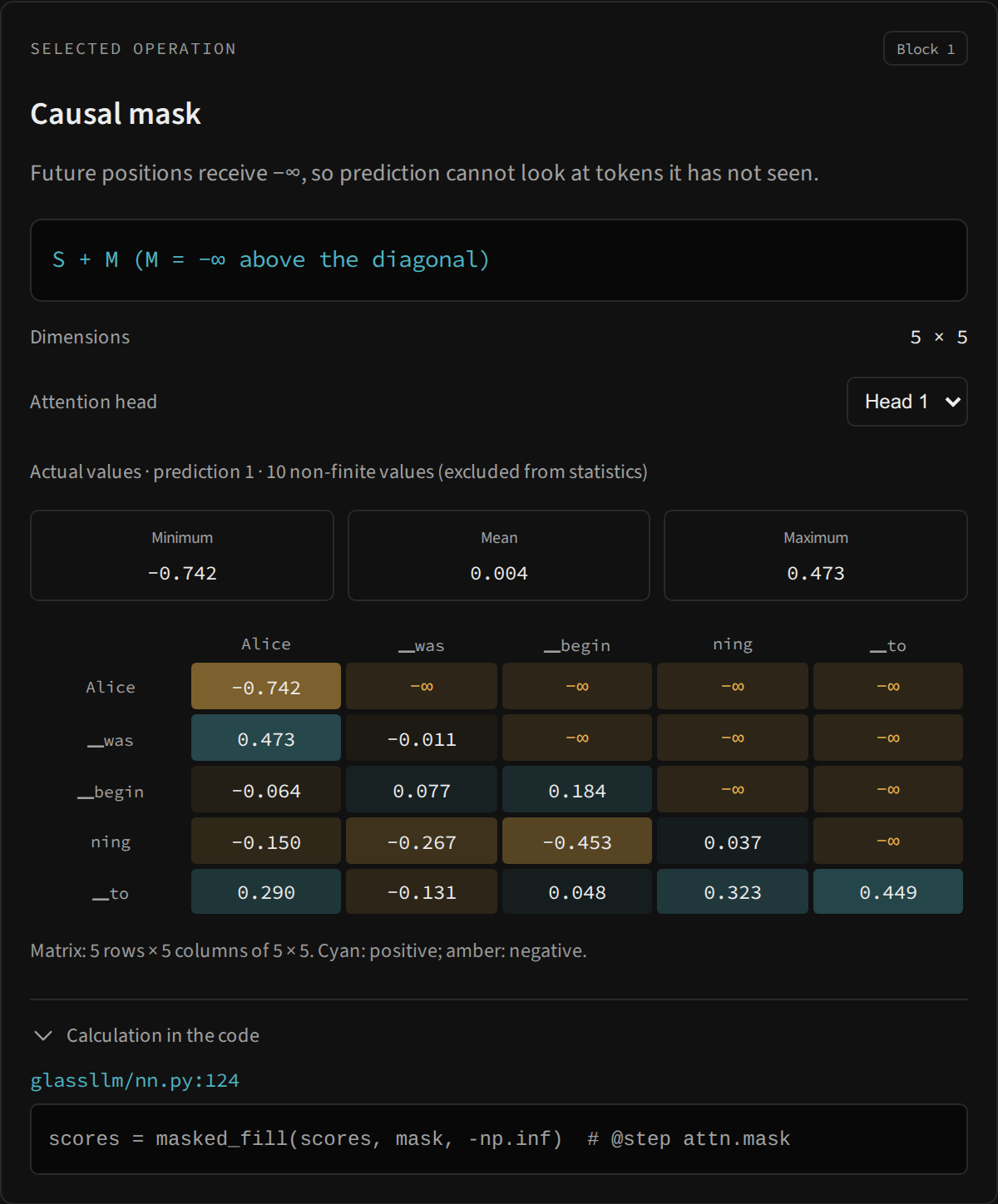
Record an execution
from glassllm import Tracer, StepRecord, STEPS imports inspection APIs. Tracer() starts with an empty records: list[StepRecord]. It copies values at marked model locations: it neither pauses computations nor independently computes attention, and it does not record every elementary NumPy operation. Interface slow motion replays these snapshots after execution.
record(step_id: str, value, layer: int | None = None, batched: bool = True, *, head: int | None = None) -> None accepts a Tensor or an array-convertible value. step_id must exist in STEPS, otherwise KeyError is raised. batched=True requires and removes a leading axis of size 1; a scalar or larger batch raises ValueError. Use batched=False for scalars, probability vectors or values already without batch.
The recorded array is an independent copy of the input. order is its zero-based list position. Supplied layer and head selectors must be nonnegative integers; booleans are rejected. Heads are only permitted for HEAD_STEPS IDs. The tracer does not validate a layer against a model or require a layer for block IDs; that is the caller’s responsibility.
import numpy as np
from glassllm import Tracer

trace = Tracer()
value = np.ones((1, 2, 3), dtype=np.float32)
trace.record("embed", value)
value[:] = 7
record = trace.get("embed")
assert record.shape == (2, 3)
np.testing.assert_array_equal(record.value, np.ones((2, 3)))
assert record.order == 0
trace.record("sample", np.array(4), batched=False)
assert int(trace.get("sample").value) == 4
The submodule helper glassllm.trace.record(trace: Tracer | None, step_id, value, layer=None, batched=True, *, head=None) -> None invokes the method when a tracer exists and does nothing for trace=None. Layers use this adapter.
Query without ambiguity
get(step_id: str, layer: int | None = None, head: int | None = None) -> StepRecord returns the first matching snapshot. Omitting a layer does not mean the last layer; omitting a head returns the stored array. Reusing a tracer appends records across calls, so the first value remains the oldest. Prefer one tracer per forward or inspect records directly for a timeline.
A full head snapshot has shape (H,n,...). get(..., head=h) selects the leading axis and returns a new StepRecord with head=h, keeping its order and equation. That slice may share memory with the full snapshot; do not modify it if the observation must be preserved. A record stored with explicit head=h is already sliced and matches only that selector.
Negative, boolean or noninteger selectors and out-of-range heads raise ValueError; missing records raise KeyError. Selecting a head for an ID without a head axis also raises ValueError. step_ids() -> list[str] returns distinct IDs in order of first occurrence, without repetitions across blocks.
import numpy as np
from glassllm import Config, GlassLM

model = GlassLM(Config(vocab_size=8, d_model=8, n_layers=1,
                      n_heads=2, n_kv_heads=1, max_len=4))
step = next(model.generate([1, 2, 3], 1, greedy=True, trace=True))
assert step.trace is not None
attention = step.trace.get("attn.softmax", layer=0, head=1)
assert attention.shape == (3, 3)
assert attention.head == 1
np.testing.assert_allclose(attention.value.sum(-1), 1.0, rtol=1e-5)
assert len(step.trace.records) == 23
StepRecord and StepInfo
StepRecord(id: str, layer: int | None, value: np.ndarray, order: int, head: int | None = None) is a frozen dataclass. shape returns value.shape; equation reads the plain text in STEPS[id]; latex reads its LaTeX formula. The class does not make value immutable. StepInfo(latex: str, plain: str), from glassllm.steps, is the frozen dataclass storing both equation formats.
The 25 IDs and repeated events
STEPS contains 25 IDs. LAYER_STEPS contains the 18 operations executed per block; HEAD_STEPS contains the 9 that retain a head axis. Equations are identical in PT/EN; prose and labels live on the site.
| Step | Recorded shape, without batch | Head |
|---|---|---|
embed, norm.final |
(n,d) |
No |
norm.attn, resid.attn, norm.ffn, resid.ffn |
(n,d) per block |
No |
attn.q, attn.rope_q |
(Hq,n,dk) |
Q |
attn.k, attn.v, attn.rope_k |
(Hkv,n,dk) for new positions |
K/V |
attn.scores, attn.mask, attn.softmax |
(Hq,n,m) including cached keys |
Q |
attn.mix |
(Hq,n,dk) |
Q |
attn.out, ffn.down |
(n,d) per block |
No |
ffn.gate, ffn.up, ffn.act |
(n,int(8*d/3)) per block |
No |
logits |
(n,V) |
No |
probs |
(V,) |
No |
sample, loss |
Scalar | No |
loss.grad |
(n,V) |
No |
For L blocks, forward records 18*L + 3 events. Generation adds probs and sample: 4 blocks yield 77 events, although only 23 distinct IDs execute. Loss adds loss and loss.grad to the 75 forward events, also yielding 77, with another set of 23 IDs. Generation never includes loss.
Equation and source line
scan_markers(package_dir: Path = PACKAGE_DIR) -> dict[str,dict] scans Python comments # @step <id> in immediate .py modules and returns {id: {"file": "glassllm/x.py", "line": n}}, with one-based lines. Duplicate markers raise ValueError; lookalike text inside strings does not count. load_step_index() -> dict[str,dict] reads the packaged step_index.json; it does not automatically recompute line numbers.
from glassllm import STEPS
from glassllm.steps import HEAD_STEPS, LAYER_STEPS, load_step_index, scan_markers

assert len(STEPS) == 25
assert len(LAYER_STEPS) == 18
assert len(HEAD_STEPS) == 9
assert scan_markers() == load_step_index()
assert load_step_index()["attn.softmax"]["file"] == "glassllm/nn.py"
After moving engine lines, run python scripts/build_step_index.py. The index identifies the operation’s source location, not a call-specific stack trace. The interface inspector displays samples with non-finite values such as −∞; they are actual causal-mask values.