Produce a prediction you can compare
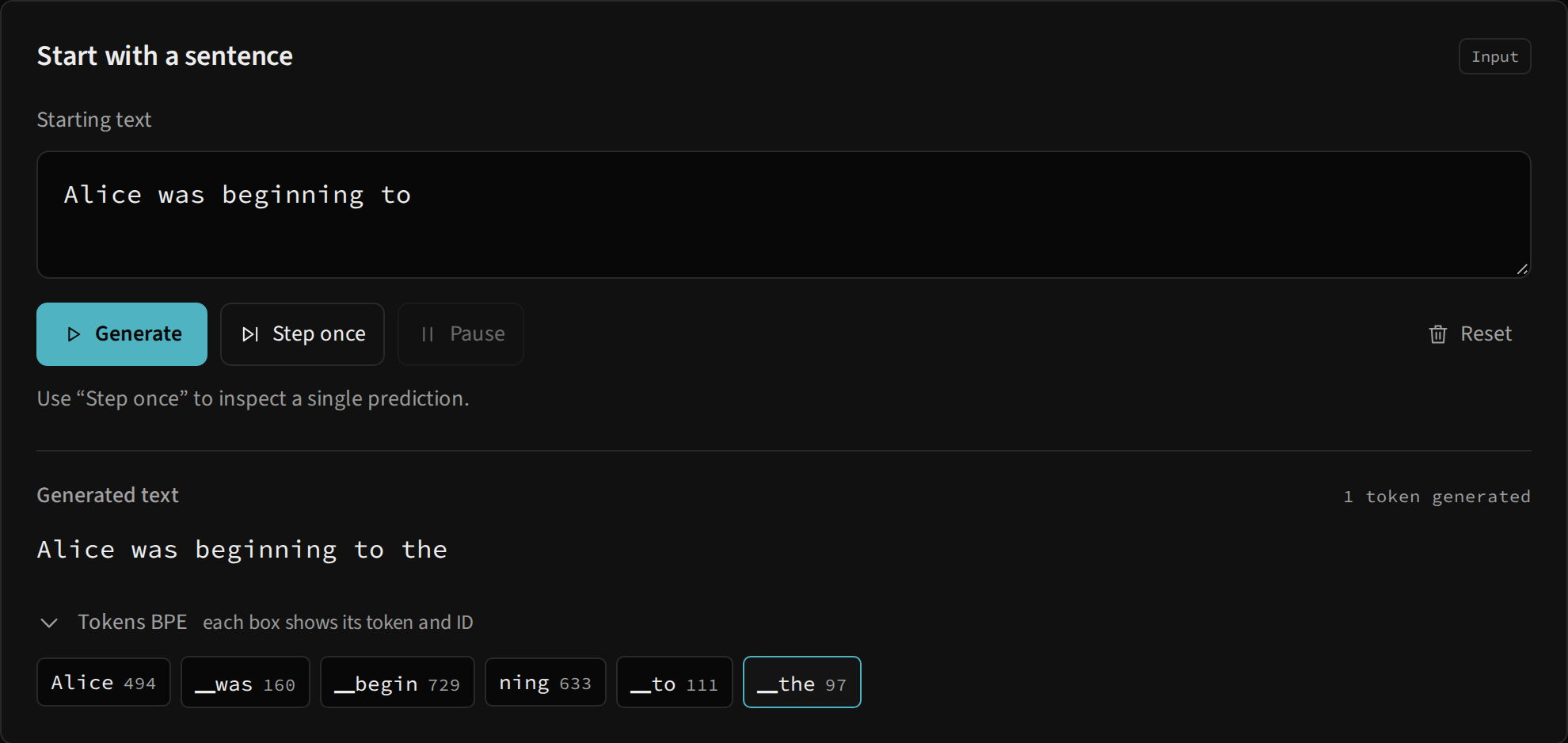
Use the same prompt, language and deterministic selection in both environments. The English lab opens with Alice was beginning to; the Portuguese lab opens with Capitu olhou para. Each model has a different tokenizer, so do not reuse IDs from one language in the other.
- Open the lab and keep the initial prompt.
- Under Token selection, choose Most likely. Keep temperature at
0.8. - Click Step once and wait for initial loading.
- Read Latest token, the continuation and the BPE tokens boxes.
- Compare Attention with Next possibilities. One panel describes the context; the other describes the output.
With the bundled assets, the English prompt produces five IDs: 494, 160, 729, 633, 111, corresponding to Alice, ▁was, ▁begin, ning, ▁to. The next greedy choice is ID 97, displayed as ▁the and decoded as the. These results were verified against the checkout’s weights; retraining or replacing the assets can change them.
Repeat the prediction in Python
After installation, save and run this code with uv run python file.py:
import numpy as np
from glassllm import load_pretrained

model, tokenizer = load_pretrained("en")
ids = tokenizer.encode("Alice was beginning to")
step = next(model.generate(
    ids, n_new=1, temperature=0.8, greedy=True, trace=True
))

print(ids)
print(tokenizer.tokens(ids))
print(step.token, repr(tokenizer.decode([step.token])))
print(len(step.trace.records))
assert np.isclose(step.probs.sum(), 1.0)

attention = step.trace.get("attn.softmax", layer=3, head=0)
print(attention.shape)
print(attention.value[-1])
assert np.allclose(attention.value.sum(axis=-1), 1.0)
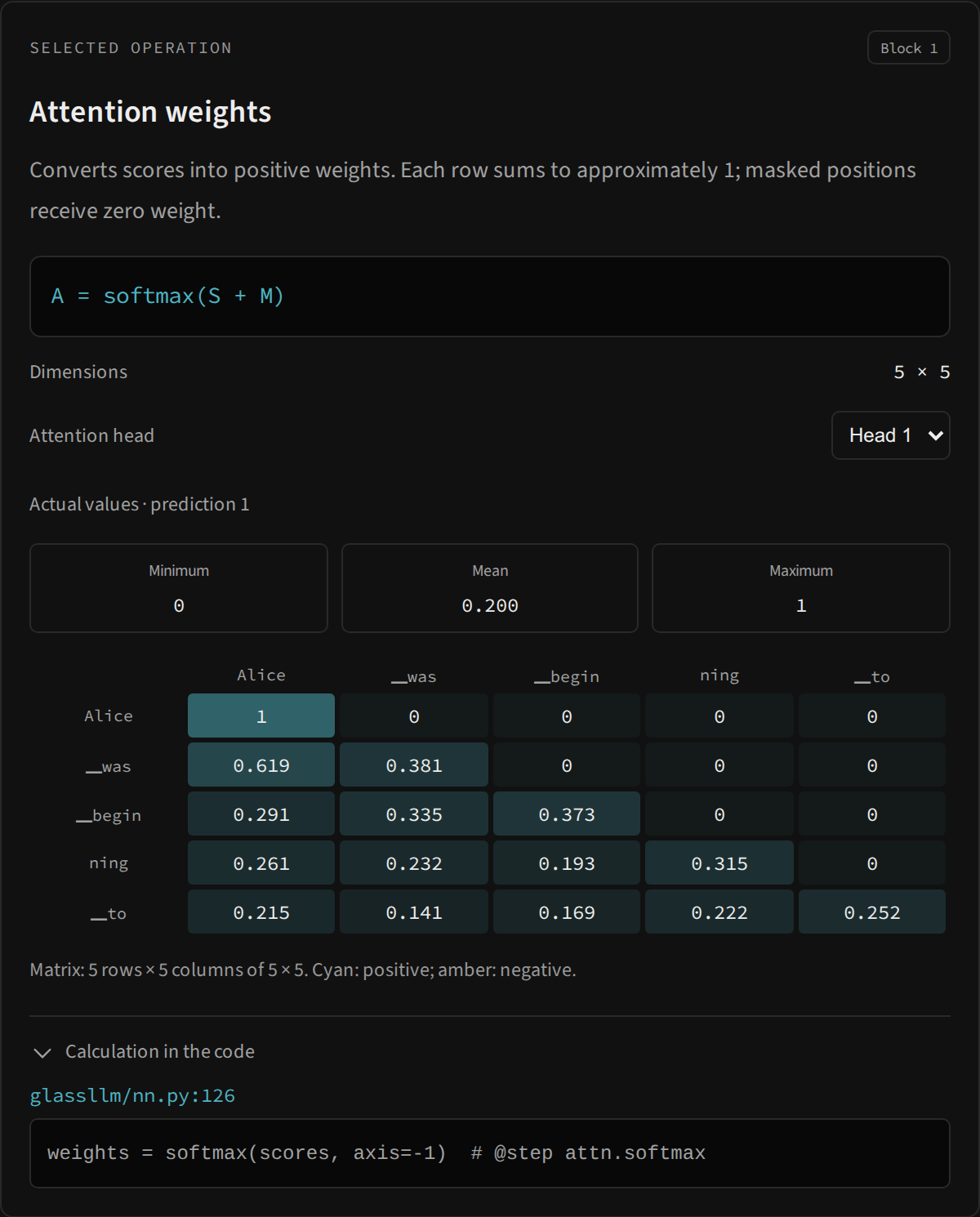
The GenStep contains the selected ID, the full output distribution and the prediction’s trace. For this prompt, there are 77 records and one head’s attention has shape (5, 5). layer=3 means the fourth block; head=0 means the first head. The lab’s compact panel uses the last row of this matrix.
To repeat in Portuguese, load "pt" and use "Capitu olhou para". The bundled assets produce six input tokens and greedy next-token ID 132, decoded as o. Do not compare the numerical meaning of IDs across vocabularies.
Check a calculation in the diagram
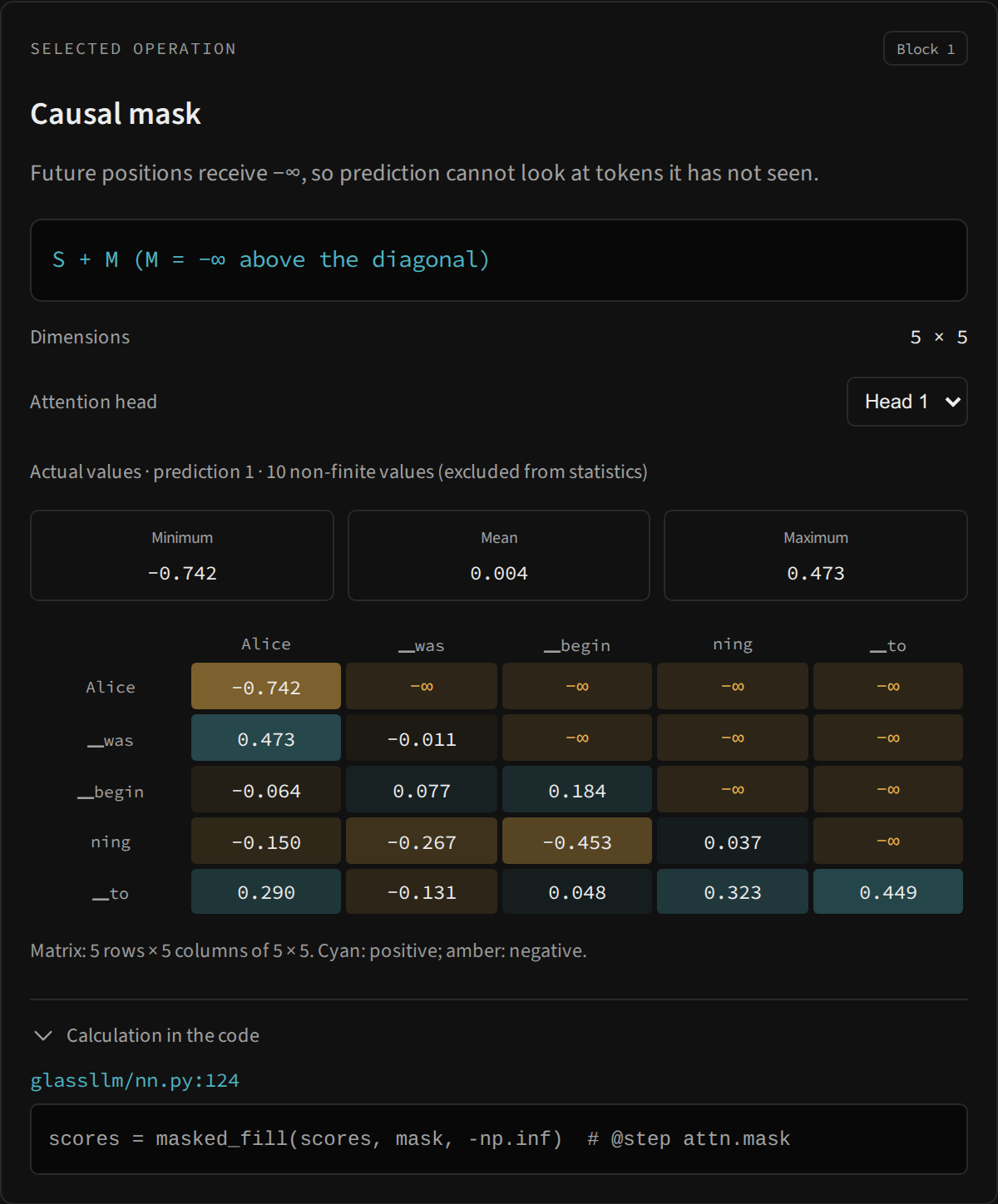
Open Explore the network, go to Block 1 and select Causal mask. The inspector shows the equation, dimensions, values and line applying the mask. In the first prediction, the entire prefix is computed; future positions in the matrix receive −∞.
You can inspect the same tensor without starting generation:
from glassllm import Tracer

tracer = Tracer()
model.forward(ids, trace=tracer)
mask = tracer.get("attn.mask", layer=0, head=0)
print(mask.equation)
print(mask.value)
forward records logits and internal operations, but not selection or the generation distribution: those two steps belong to generate. In the English example, one head’s mask contains 10 −∞ positions above the diagonal. After softmax, those positions receive zero weight.
Study without losing the current prediction
Enable Slow motion and click Replay flow. Use Pause flow at an interesting operation; Previous calculation and Next calculation walk through the same records. You do not need a new prediction to revisit the tensor.
When you generate another token, panels describe the new prediction. With the cache, queries usually have only one position and the attention matrix becomes 1 × m. For a clean experiment with another prompt or selection method, click Reset, edit the input and start again. Continue with slow motion and the inspector.