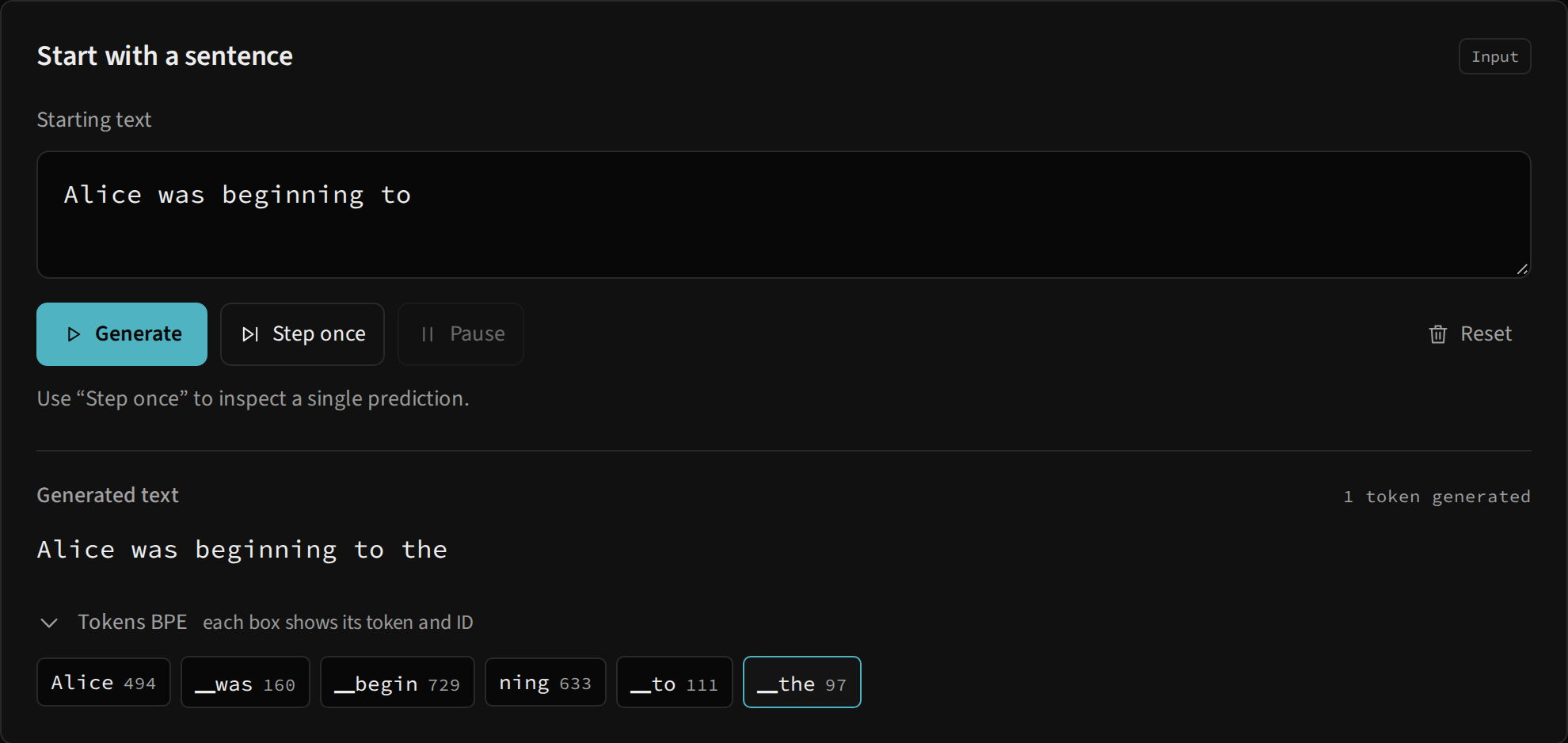
From text to IDs
The Transformer consumes integers. Each ID identifies a vocabulary entry: a letter, punctuation mark, subword or word learned through merges. A token does not necessarily correspond to a word or a byte.
glassllm implements BPE over Unicode characters in src/glassllm/tokenizer.py. It does not use the SentencePiece library and has no byte fallback mechanism. The Portuguese and English models have separate vocabularies of 1,024 entries. An ID can represent different text in each language.
Text → NFC normalization → chunks → BPE merges → pieces → IDs
IDs → pieces → remove special tokens → replace ▁ with spaces → text
Normalization and boundaries
pre_tokenize(text) first normalizes Unicode to NFC, treating a letter plus a combining accent as its equivalent composed form. It then replaces ordinary spaces with ▁ and separates chunks using a regular expression. Spaces preceding a word may belong to that word’s chunk; a newline forms its own chunk. Merges never cross these boundaries.
For example, pre_tokenize("Era uma vez\n") produces ['Era', '▁uma', '▁vez', '\n']. The ▁ marker makes a space visible in the token panel. It does not add a letter to the decoded text.
| Special token | Fixed ID | Decoding |
|---|---|---|
<pad> |
0 | Omitted |
<unk> |
1 | ⁇ |
<bos> |
2 | Omitted |
<eos> |
3 | Omitted |
encode does not automatically insert BOS or EOS. Unknown characters become <unk>, so decoding cannot recover characters missing from the alphabet. NFC also means the original Unicode encoding may not be preserved byte for byte.
How merges are learned
Tokenizer.train(text, vocab_size) counts chunks and adjacent pairs. Each round selects the most frequent pair, replaces non-overlapping occurrences and records the merge. Frequency ties are resolved by alphabetical pair order, making training deterministic for the same text.
The initial vocabulary contains the four special tokens and the observed alphabet. Each merge adds an entry. Training stops before the requested size when no pairs remain. Requesting fewer entries than the alphabet plus specials raises ValueError.
During encoding, the learned merge order determines the next pair to combine. Looking for the longest vocabulary piece is insufficient: ranks retains each merge’s priority.
Reproducible example
This small corpus lets you inspect every stage:
from glassllm import Tokenizer

t = Tokenizer.train("banana banana", vocab_size=12)
print(t.merges)
print(t.encode("banana banana"))
print(t.encode_verbose("banana")[0]["steps"])
print(t.decode(t.encode("banana banana")))
Verified output:
[('a', 'n'), ('an', 'a'), ('an', 'ana'), ('b', 'anana')]
[11, 7, 11]
[['b', 'a', 'n', 'a', 'n', 'a'],
 ['b', 'an', 'an', 'a'], ['b', 'an', 'ana'],
 ['b', 'anana'], ['banana']]
banana banana
The second chunk’s space stays separate because no ('▁', 'banana') merge was learned. With this tokenizer, t.encode("🙂") returns [1].
Connection to the interface and engine
With the project’s packaged Portuguese tokenizer, "Era uma vez" maps to [35, 120, 219, 373], with pieces ['E', 'ra', '▁uma', '▁vez']. Use tokens(ids) to inspect pieces and decode(ids) to read text. This API has no id_to_token method.
The token panel displays these IDs. The next stage, embed, uses each ID to look up a row in E. encode_verbose exposes merge stages; these are not Tracer snapshots, which begin inside the model.
References and limitations
Sennrich, Haddow and Birch discuss BPE subword units in Neural Machine Translation of Rare Words with Subword Units, first preprint in 2015. Kudo and Richardson’s 2018 SentencePiece paper provides context for explicit space representation. This implementation has its own chunk, normalization and merge rules. The papers’ results are not evaluations of this small model.